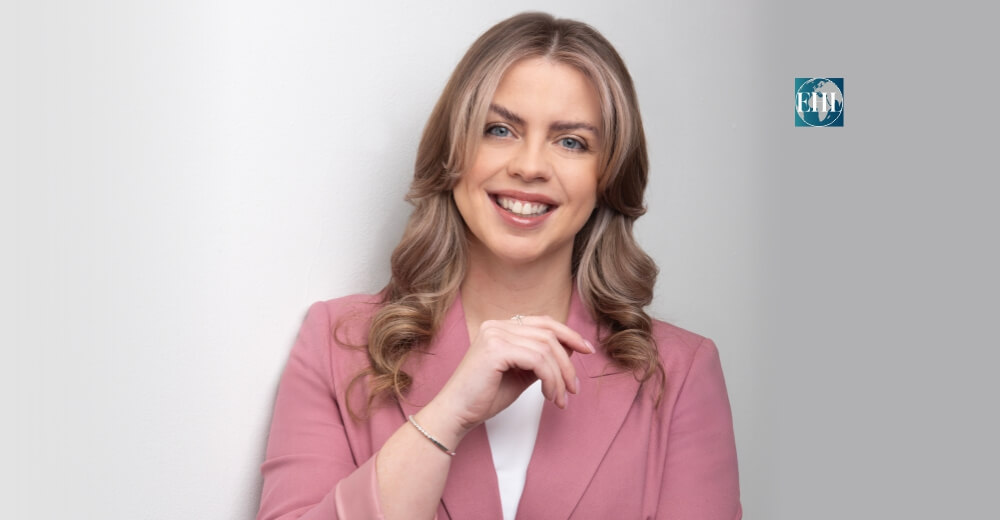
Raised in a bilingual household by Polish parents who moved in search of better opportunities for their children, Nicole Cienskowski developed an early connection to healthcare through her mother’s work as a hospital nurse. Watching doctors, researchers, nurses, and caregivers up close, she was inspired by their resilience and the real difference they made in people’s lives. These early experiences shaped her desire to work in healthcare.
When entry into medical school was not immediately possible due to strict requirements, Cienskowski chose a different path rather than waiting. Motivated by a strong wish to contribute, she studied economics with a focus on health economics and healthcare management at Freie Universität Berlin and later at the Technical University of Berlin. While demanding, her studies were rewarding and helped her build a strong network within the German healthcare sector.
She completed her master’s degree with top distinction at Charité University Hospital, where her thesis focused on the digitalization of doctors’ rounds. Working closely with hospital teams gave her insight into the daily challenges of clinical environments and strengthened her belief that technology can improve how healthcare is delivered.
Today, Cienskowski is Director and Public Healthcare Lead Germany at Capgemini. In this role, she works with public healthcare organizations to design and implement digital solutions that improve processes, support professionals, and deliver better outcomes for patients. She continues to see her work as a meaningful opportunity to help shape a more efficient, resilient, and people-centered future of care.
Let’s delve into the interview details below!
As a Client Executive at Capgemini, how do you define your mission when working with public healthcare organizations in today’s rapidly evolving digital landscape?
Since I have not chosen a healthcare profession in the classical sense, I define my mission, and that of my team, as contributing to the creation of added value for the healthcare clients we serve across health insurance, hospitals, and health authorities by using modern technologies and project methods. At the same time, I am very aware that technology is only a means to an end. The added value and acceptance of a new solution or business model are always central to my work.
Digitalization and artificial intelligence are developing rapidly, but I am not a fan of hype. I advocate for sustainable results that convince users by solving real problems or optimizing existing processes. Depending on the context, users can be healthcare professionals such as doctors, epidemiologists, and researchers, as well as patients.
What do you see as the biggest pain points or barriers to modernization, and how is Capgemini helping solve them?
In the German market, I see three main challenges: finding the right balance between data protection and data use for research and targeted healthcare; improving the system’s ability to respond to crises such as pandemics or natural disasters while remaining open to emerging technologies and medical ethics; and having the courage to adopt new processes, including holistic AI approaches for individualized, citizen-centered care.
The ongoing development of electronic patient records in Germany clearly shows that adoption is key. Even the most secure and advanced solution will not succeed if users do not see clear added value.
Capgemini works with healthcare organizations worldwide across public healthcare, life sciences, and medtech. Our work ranges from strategic advisory and solution design to large-scale transformation, modernization, and operations. Through national lighthouse projects such as health data hubs and digital strategies for public health services, we combine industry expertise with technology know-how. By using AI, we increase efficiency in health insurance services, enable faster decision-making, support research, and contribute to a more targeted healthcare.
From your perspective, what emerging technologies—such as AI, predictive analytics, virtual care, or automation—are creating the biggest opportunities for improving patient outcomes and operational efficiency?
AI is everywhere. I value the technology not because of the hype, but because valuable AI use cases and measurable outcomes can be realized for all healthcare stakeholders, including healthcare providers, cost bearers, and patients.
I am also a strong supporter of the concept of “health regions,” which are designed to overcome fragmentation in healthcare and promote collaboration among providers, cost bearers, health service navigators, inpatient and outpatient care, and rehabilitation centers. These regions often also include innovative, non-traditional healthcare solution providers for example Uber Health offering low-threshold services.
In Germany, the Lausitz healthcare pilot region is one such example. In the coming years, a digitally supported network of healthcare providers will be established in the region and connected to the University Hospital Carl Thiem Lausitz as a leading digital hospital in the region. The goal is to strengthen collaboration between care, research, and teaching, and to test new, data-driven care models together with solution providers and partners, including start-ups. Capgemini contributes its experience from national digital health and health data platform initiatives in Germany, combining data expertise with advanced analytics and AI‑driven use cases.
What has your experience been like as a woman leader in this space, and how do you see gender diversity influencing innovation in healthcare tech?
In decision-making meetings at client organizations, I was often the only woman or one of very few. Over the past three years, I have observed a noticeable increase in women in leadership positions, likely influenced in part by gender quotas in some countries. I am not generally a fan of quotas, as I believe in talent and potential regardless of age, gender, or background. However, if quotas help reduce structured and unexplained power imbalances, I can accept them.
Diverse teams are more successful, a fact confirmed by numerous studies as well as my own experience. Personally, my experience as a female leader has been mixed. I am sometimes underestimated because of my age and appearance, despite more than 12 years of experience in the healthcare sector. However, results and expertise quickly take center stage and tend to overcome these preconceptions.
I try to stay focused on the challenges rather than overemphasizing gender discussions. Talented women will find their way into CxO roles, and I actively support them on this journey by serving as a mentor and engaging in initiatives such as the Female Future Leaders program by Axel Springer SE.
How do you approach building trust and alignment with public sector clients, especially when dealing with long-term, mission-critical healthcare initiatives?
For me, the trust formula is clear: credibility, reliability, and approachability on an interpersonal level. Credibility is the foundation. We build trust by showcasing our long-term client relationships within public healthcare, as well as with life sciences and medtech companies, and by bringing together clients from different industries who face similar challenges or share a willingness to explore new technologies. Credibility is also strengthened through my own project experience and my involvement in healthcare initiatives.
Reliability, especially during challenging project phases, is equally important. As the person responsible for the health sector, I have learned to remain calm and work in a solution-oriented manner during critical situations. The reality is that while there are many project successes, everyone, myself included, sometimes makes wrong decisions. Mistakes happen, but accepting them, adapting quickly, and collaborating in a solution-focused way are key to building sustainable client relationships.
I believe that success and strong partnerships often emerge from critical phases, because those moments reveal true character. If you manage to stay on course together during difficult times, the partnership becomes truly strong.
How do you ensure the digital solutions you champion remain human-centric, equitable, and scalable?
In my projects, I work closely within the client’s environment, listening, understanding their success factors, and tailoring solutions accordingly. Our projects are as diverse as our portfolio, from AI-driven service redesigns to complex IT modernization programs and future-oriented innovation labs.
In my work, I rely on flexible approaches that can be adapted to each client’s specific needs. Solutions are developed collaboratively with our clients, combining their knowledge with our industry expertise and project experience.
For scalability, we work with global and local partners, start-ups, and a global delivery model. AI enables us to accelerate projects with minimal expert intervention. To ensure equity, we focus on client enablement, delivering in mixed teams so clients can continue projects independently. End-users are involved in design and testing, using capabilities such as frog’s reinvention labs and Applied Innovation Exchange Hubs to create solutions that generate real value from the start.
Can you share a recent project, innovation, or milestone at Capgemini that you believe best represents your commitment to advancing the future of care?
My team is contributing to a national flagship project in Germany that consolidates pseudonymized data from a large number of health insurers to make it available for research institutions. Synthesized data are also derived from these datasets. Once approved, researchers gain temporary access to secure analyzing rooms to conduct their projects. By unlocking this long-standing trove of health data, we enable better medical care.
Another initiative is the AMIGO project, which aims to support faster diagnoses for children with rare diseases. It was launched in collaboration with the Dr. von Hauner Children’s Hospital in Munich and MI4People, with Capgemini’s involvement. AMIGO, which stands for Advanced Medical Intelligence for Guiding Omics-based Medicine, aims to provide faster diagnoses for children with rare diseases. By combining machine learning with a decentralized approach, clinical and genetic data can be securely analyzed and linked. The knowledge gained trains AI to support doctors in providing individualized and personalized care.
Looking ahead, what shifts do you predict will redefine public healthcare over the next 5 years, and how can organizations—including Capgemini—prepare for this next era of digital health?
Pandemics, natural disasters, other crises, and demographic changes are placing increasing cost pressures on global healthcare systems, alongside an aging population and a rise in critical care cases. To meet these challenges and maintain or improve quality of care, humans will increasingly need to collaborate daily with artificial intelligence and humanoid robots.
Capgemini leverages global AI capabilities and local AI Accelerators to develop AI-empowered solutions through a holistic approach. We consider change management, governance, experimentation with emerging technologies, collaboration with specialized start-ups, and the ethical use of AI. We also continuously transform our own business model to keep pace with rapid technological and market developments. AI can only be deployed with credibility if a company adapts both internally and for its clients. Recent acquisitions by Capgemini have expanded the capabilities available to my teams, particularly in areas like data, cloud, AI-driven transformation, end-to-end transformation, and business partnership.
Finally, what advice would you offer to women aspiring to lead in digital healthcare or to professionals eager to shape the future of public health through technology?
Today’s challenges in healthcare systems around the globe require the contribution of every capable expert. Identify the concrete contribution you can make and start taking action. Find the right networks of collaborators and partners, and focus on your potential instead of overthinking decisions. Building expertise and achieving success are not dependent on gender, but on your assertiveness and resilience, and you will find your place as a leader in digital healthcare.